Typhoon & Black Rainstorm Work Guide for Employees: Your Rights Before, During, and After Bad Weather in Hong Kong
- Jul 8
- 6 min read
Safeguarding Employee Rights During Adverse Weather
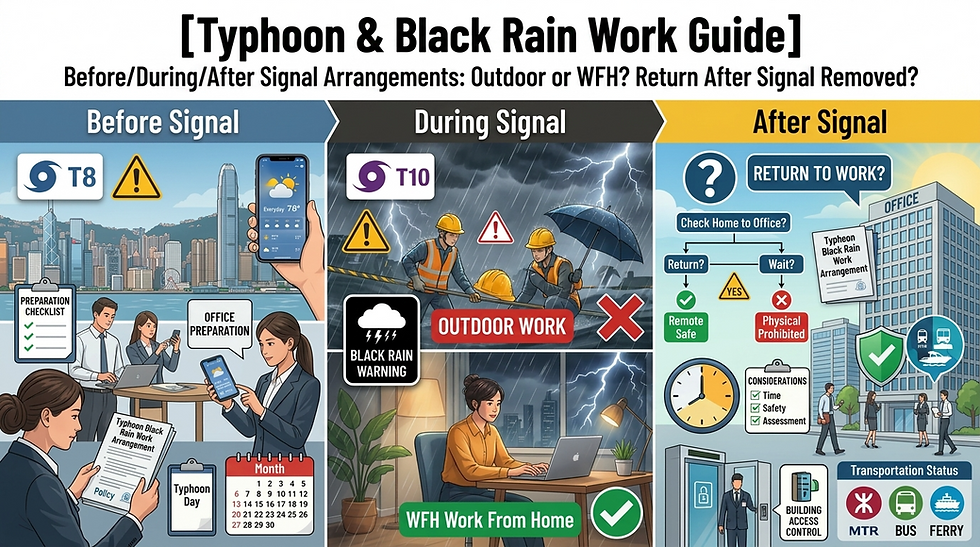
Every year, Hong Kong experiences several typhoons and black rainstorms. When the Observatory issues adverse weather warnings, employees often wonder: "Do I need to go to work?" "Will my salary be deducted?" "Do I still need to work from home (WFH)?" These questions not only concern personal safety but also involve complex labor laws and employment rights. Many employees, unaware of their rights, are forced to risk going to work during adverse weather or suffer unfair treatment due to misunderstandings of the law.
This article aims to provide a comprehensive "Typhoon and Black Rainstorm Work Guide" for Hong Kong employees, deeply analyzing your rights regarding attendance, wages, and work injury protection during adverse weather and "extreme conditions." We will cite the latest guidelines from the Labour Department and relevant ordinances to help you clearly understand your rights and protect yourself when facing unreasonable demands from employers. This article will also integrate the professional HR consulting services of Get More Resources Limited to provide you with practical support.
1. Legal Basis for Adverse Weather Work Arrangements: Code of Practice, Not Law?
Hong Kong currently does not have a specific "Typhoon Leave Law." While the Code of Practice in Times of Adverse Weather and "Extreme Conditions" (hereinafter referred to as the "Code") issued by the Labour Department is not legally binding, courts refer to it as an important reference in labor disputes. Employers who do not comply may face legal risks.
1.1 Legal Status and Reference Value of the "Code"
The "Code" aims to assist employers and employees in making prior work arrangements during adverse weather to ensure employee safety, maintain organizational operations, and foster good labor relations. Although the "Code" itself is not mandatory legislation, its content reflects the Labour Department's expectations for reasonable employment practices. If an employer violates the "Code" and employee rights are infringed, for example, due to work injury caused by unreasonable demands or illegal wage deductions, they may violate relevant ordinances such as the Employees' Compensation Ordinance or the Employment Ordinance.
1.2 Special Arrangements Under "Extreme Conditions"
Since 2019, the government has introduced an "extreme conditions" announcement mechanism to respond to situations after super typhoons or large-scale damage. Under "extreme conditions," employers should not require employees to go to work, except for essential personnel. This arrangement aims to give employees ample time to travel to and from work and ensure their safety.
2. Before, During, and After Typhoons/Black Rainstorms: Employee Rights and Responsibilities
Answer Capsule: During adverse weather, employee rights vary depending on the timing of the warning signal, the nature of work (outdoor/indoor/WFH), and prior arrangements made by the employer. Understanding these details is key to protecting your rights.
2.1 Before the Signal: Early Dismissal – A Privilege or a Right?
•Typhoon Signal Pre-warning: When the Observatory anticipates issuing a Tropical Cyclone Warning Signal No. 8 within two hours during working hours, employers should arrange for employees to leave work in batches according to agreed work arrangements. This is not a mandatory law but a good employment practice recommended by the "Code".
•Employee Rights: If the employer does not arrange for early dismissal, and public transport is suspended or there are safety risks after Signal No. 8 is issued, employees have the right to choose not to go to work. Employers should not deduct wages or penalize employees for this.
2.2 During the Signal: WFH Still Required? Is Outdoor Work Protected?
Scenario | Employee Rights and Responsibilities | Legal Basis/Recommendation |
Indoor Work | If the employer has pre-agreed WFH arrangements with employees, employees should work from home as agreed. If there is no prior agreement, employees may refuse. | The "Code" encourages flexible handling, but prior agreement is required. |
Outdoor Work | Employers must ensure the safety of employees working outdoors during adverse weather. If there is danger, employees have the right to refuse to work. | The Occupational Safety and Health Ordinance requires employers to provide a safe working environment. |
Essential Employees | For essential employees who must go to work (e.g., healthcare, security), employers should provide additional allowances, transport, or safe accommodation. | The "Code" recommends this to ensure the safety of essential employees. |
2.3 After the Signal: Must I Return to Work Within 2 Hours?
The Labour Department's "Code" suggests that when Tropical Cyclone Warning Signal No. 8 or above, Black Rainstorm Warning, or "extreme conditions" cease, employees should "endeavor" to return to work within 2 hours if more than 3 hours of working time remain. This is a "best effort" guideline, not a mandatory law.
•Flexible Handling: Employers should consider individual employee circumstances, such as traffic disruptions or damage to homes, and handle them flexibly. They should not easily penalize or dismiss employees who cannot return to work on time.
•Travel Allowance: If employees incur additional travel expenses (e.g., taxi) due to adverse weather, employers should consider providing a travel allowance.
3. Wages, Leave, and Work Injury Protection During Typhoons and Black Rainstorms
Employers must not deduct employee wages or statutory leave due to adverse weather. In specific circumstances, injuries sustained while traveling to and from work during adverse weather may also be considered work injuries.
3.1 Wages and Leave: Legal Consequences of Illegal Wage Deductions
•Prohibition of Wage Deduction: According to Section 32 of the Employment Ordinance, employers must not deduct employee wages for failure to attend work due to adverse weather, unless the employee is voluntarily absent without the employer's consent.
•Prohibition of Leave Deduction: Employers must also not use employee annual leave, statutory holidays, or rest days to offset working time lost due to adverse weather. Violators may be prosecuted.
•Legal Consequences: Illegal wage deductions can result in a maximum fine of HK$350,000 and imprisonment for 3 years.
3.2 Work Injury Protection: Application of the 4-Hour Rule
According to Section 5(4)(f) of the Employees' Compensation Ordinance, if an employee sustains an injury by accident while traveling by a direct route between their residence and place of work within four hours before the commencement or after the cessation of their working hours on that day, during the period when Tropical Cyclone Warning Signal No. 8 or above, a Red or Black Rainstorm Warning, or "extreme conditions" are in force, the accident shall be deemed to have arisen out of and in the course of employment, and the employer shall be liable for compensation.
•Importance: This provision provides an important safety net for employees traveling to and from work during adverse weather. Employees should retain relevant travel proof for future reference.
4. Employee Self-Protection Guide: Practical Advice During Typhoons and Black Rainstorms
Answer Capsule: Employees should proactively understand company policies and prioritize their safety during adverse weather. Retaining evidence and seeking assistance are key to protecting their rights.
4.1 Understand Company Policies and the "Code"
•Check Company Handbook: Understand if the company has a clear policy for adverse weather work arrangements.
•Refer to Labour Department's "Code": Even if the company has no policy, you can still refer to the "Code" to determine if the employer's demands are reasonable.
4.2 Prioritize Personal Safety
•Right to Refuse Work for Safety: If you believe there is a danger in traveling to and from work during adverse weather, you have the right to refuse to go to work or resume work. You should notify your employer as soon as possible and explain the reasons.
•Retain Evidence: If you cannot return to work on time due to traffic disruptions, you should retain relevant proof (e.g., public transport suspension notices, news reports).
4.3 Seek Professional Assistance
•Labour Department: If an employer engages in unreasonable wage deductions, leave deductions, or dismissal, you can seek assistance from the Labour Department.
•Professional HR Consultants: When facing complex labor disputes, seeking advice from professional HR consultants can more effectively protect your rights.
Know Your Labour Rights, Protect Your Workplace Dignity.
In the workplace, a clear understanding of your own rights and obligations is fundamental to safeguarding your personal interests. The professional HR consultancy team at Get More Resources Limited specialises in analysing the Employment Ordinance and relevant regulations, providing employees with objective and professional rights assessment and guidance. Whether you are facing concerns over contract terms or encountering unfair treatment in the workplace, we are equipped to help you clarify your situation from a professional perspective and make well-informed decisions.
Professional advice to help you stand firm. Register now for a complimentary rights consultation:
📞 (852) 2333 1090
Make Get More your strategic HR partner, empowering you to defend your own rights.
Disclaimer:
The content of this article is for informational purposes only and is intended to provide general legal information and HR management advice. It does not constitute professional legal advice in any form. Hong Kong's laws and regulations may change at any time, and each case has its unique circumstances. Readers should consult a professional lawyer or the Labour Department before making any business or legal decisions. Get More Resources Limited is not responsible for any loss or impact arising from the use of the information in this article.


