ESLS Local Recruitment Requirements Update: Why Hong Kong Employers May Face Administrative Sanctions — Recruitment and Interview Records Checklist
Updated: Aug 30
Applying for imported labour is more than posting an advertisement
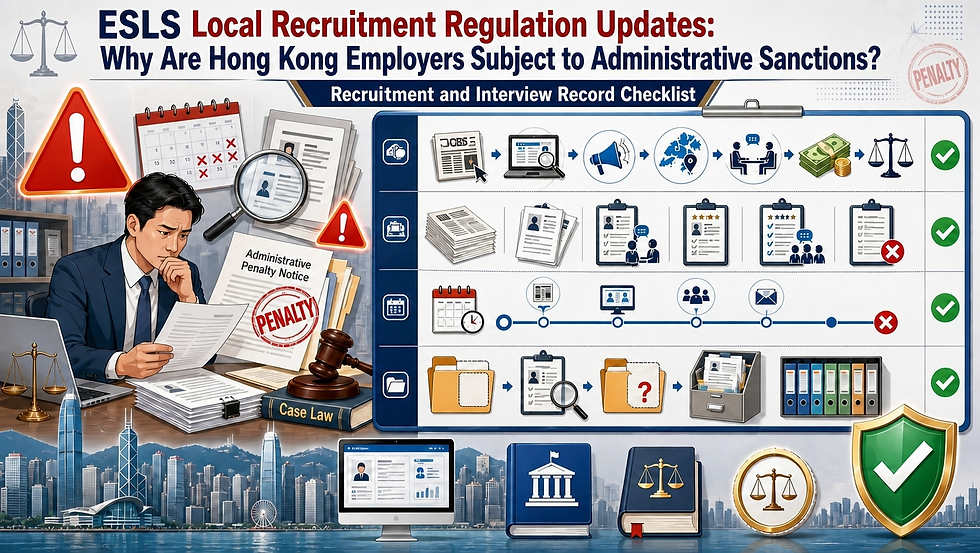
When a company applies under the Enhanced Supplementary Labour Scheme (ESLS), it cannot simply show that a recruitment advertisement was posted. The employer must also conduct open local recruitment as required by the Labour Department and handle applicants and interview arrangements in accordance with the approved job conditions during the recruitment period.
For HR teams, the most important questions are not only whether recruitment took place, but also:
• Are the recruitment conditions consistent with those approved by the Labour Department?
• Were the recruitment advertisements published as required, with proper records retained?
• Were qualified local applicants given reasonable consideration and an opportunity to attend an interview?
• If an applicant was not hired, is there an objective and traceable assessment record?
• Can the company submit complete recruitment results within the specified timeframe after recruitment ends?
The Labour Department’s official ESLS information states that if an employer breaches the open-recruitment requirements—for example, by employing local workers at wages below the prescribed level, or by unreasonably refusing to interview or employ qualified local applicants during open recruitment—the Labour Department may reject the relevant application and consider imposing administrative sanctions.
Recent official reminder: administrative-sanction risks deserve a fresh review
The Labour Department’s press-release index lists a press release dated 11 August 2026 concerning an employer subject to administrative sanctions for breaching ESLS local recruitment requirements. Because administrative sanctions depend on the specific facts and official investigation findings, companies should not infer the legal consequences of every case from a headline alone. Always review the latest Labour Department press release and ESLS documents directly.
The purpose of this update is not to simplify an individual case into “one particular mistake will always lead to a ban”. It is to remind employers that:
• Local recruitment is not merely a procedural formality;
• Interview and selection decisions should be supported by reasonable and coherent records;
• Once job conditions have been approved by the Labour Department, the employer should not change them independently during recruitment; and
• Recruitment documents should enable the company to explain, at a later stage, how it handled each applicant.
Where does local recruitment fit into the ESLS application process?
The general process can be summarised as follows:
• The employer prepares the position, salary and company information;
• The proposed position passes the Labour Department’s preliminary screening;
• The employer conducts open local recruitment and arranges interviews as required by the Labour Department;
• After the recruitment period ends, the employer organises the recruitment information and results for submission;
• The Labour Department assesses the application and local recruitment results; and
• If approval in principle is granted, the employer submits individual visa/entry-permit applications to the Immigration Department within the specified period.
The Labour Department’s ESLS frequently asked questions state that after a position passes preliminary screening, the employer must conduct open local recruitment as required. The employer must also publish the recruitment advertisement, handle applicants and interview arrangements, and submit recruitment information and results within the specified timeframe. The actual arrangements, deadlines and forms should always be checked against the latest official guidance applicable when the application is submitted.
1. Recruitment conditions: do not “make a small change” during recruitment
During open recruitment, the recruitment conditions proposed by the employer should be consistent with those approved by the Labour Department. These conditions may include:
• Job title and scope of duties;
• Workplace location;
• Working hours and arrangements;
• Entry requirements;
• Salary level; and
• Other job conditions submitted to or approved by the Labour Department.
Common risks include:
• Describing one set of duties in the application but using a different description in the recruitment advertisement;
• Stating normal working hours in the application but telling applicants during interviews that long shifts are required;
• Adding a new entry requirement at the last minute to reduce the number of local applicants;
• Offering applicants wages below the prescribed level during the interview process; and
• Splitting one position into different conditions so that the actual recruitment no longer matches the application.
If the company believes that the job conditions genuinely need to change, it should first consult the Labour Department and follow the official process. Front-line HR staff or operations managers should not make the change independently.
2. Local recruitment advertisements: retain more than a screenshot
The company should create a recruitment file for each application position. In addition to screenshots of the recruitment advertisement, consider retaining:
• The recruitment platform and link;
• The first publication date and removal date;
• The complete advertisement content;
• The position, wage, working hours and entry requirements;
• Labour Department referral or notification records;
• Publication records for other recruitment channels;
• Records of changes to each advertisement version;
• The names of the responsible person and reviewer; and
• Emails and written correspondence with the Labour Department.
A single, outdated screenshot may not show the complete recruitment process. A more robust approach is to keep the recruitment advertisement, application records, interview records and final result in the same controlled folder, named by application position and recruitment period.
3. Interview records: not hiring someone is not automatically a problem—but the decision should be explainable
ESLS local recruitment does not mean that an employer must hire every applicant. However, if a qualified local applicant is not hired, the company should be able to explain the reason using objective and consistent information.
Interview records may include:
Record item | Suggested content |
|---|---|
Applicant information | Date of application, position applied for, contact details and source |
Interview arrangement | Invitation date, interview date, format, attendance or absence |
Position assessment | Assessment against the published duties and entry requirements |
Working conditions | Working hours, location, salary and whether these were clearly explained to the applicant |
Assessment result | Passed, not passed, further information required or applicant declined |
Reason for non-selection | Specific reason related to the job requirements |
Review information | Assessor, reviewer and decision date |
Avoid writing only “not suitable”, “did not feel right” or “insufficient experience” without any supporting explanation. A more useful record should identify which published job requirement the applicant did not meet, or what objective, job-related information was confirmed during the interview.
At the same time, records should not include irrelevant comments about age, sex, marital status, family circumstances, health condition or other sensitive matters. Recruitment records should focus on the needs of the position and the published conditions.
4. Which situations require particular attention?
The situations below do not necessarily mean that a breach has occurred, but they should be reviewed promptly by HR or management:
• An applicant appears to meet the advertised conditions but was not invited to an interview;
• Interview invitations were handled only verbally, with no date or result recorded;
• Different applicants were told different salary levels, working hours or duties;
• Every local applicant was closed out with the same unexplained reason: “not suitable”;
• The recruitment advertisement was amended after publication, but the company did not retain the earlier version;
• Interviews were handled by shop, site or branch supervisors, with no review record held by head-office HR;
• The application described one position, but the interview concerned a different job;
• The company has already employed imported workers, but the local recruitment file has not been completed; or
• The company cannot identify who was responsible for submitting the recruitment results to the Labour Department.
The common issue is that the company may later be unable to clearly reconstruct how each recruitment decision was made.
5. ESLS local recruitment compliance checklist
Before submitting the application
• [ ] Confirm whether the position is eligible for ESLS rather than another imported-labour scheme;
• [ ] Check the job title, duties, workplace, working hours, entry requirements and salary;
• [ ] Appoint one HR/administrative owner and one reviewer;
• [ ] Create a document folder for each application position; and
• [ ] Ensure front-line supervisors understand that they must not independently change approved recruitment conditions.
During open recruitment
• [ ] Publish the local recruitment advertisement in accordance with the latest Labour Department requirements;
• [ ] Retain every advertisement version and publication record;
• [ ] Use consistent job descriptions, working conditions and entry requirements;
• [ ] Record applications received and applicant sources;
• [ ] Provide qualified applicants with reasonable interview arrangements;
• [ ] Record absences, interview refusals, applicant withdrawals and similar events; and
• [ ] If the job conditions need to change, consult the official process first rather than changing them independently.
After interviews and selection
• [ ] Keep an individual assessment record for every applicant interviewed;
• [ ] Ensure each non-selection reason is related to the job requirements or interview information;
• [ ] Avoid unexplained, generic assessment comments;
• [ ] Ask HR or a designated supervisor to review the consistency of the records;
• [ ] Organise the recruitment results, statistics and supporting documents;
• [ ] Submit the information in accordance with the latest Labour Department requirements and deadline; and
• [ ] Retain the submission record and correspondence with the Labour Department.
6. The original application process and other important arrangements still require follow-up
This update focuses on local recruitment. It does not mean that other application requirements can be ignored. An ESLS application may also involve:
• Employer and business information;
• Position and salary information;
• The standard employment contract;
• Visa/entry-permit applications after approval in principle;
• The Employees Retraining Levy;
• The workplace, duties and employer arrangements for imported workers; and
• Other requirements applicable under the latest official documents.
The Labour Department’s official ESLS webpage also reminds employers that breaches of the relevant statutory provisions, ESLS requirements or standard employment contract requirements may lead to administrative sanctions. Depending on the nature of the breach, subsequent applications may not be processed, a prohibition period may last up to two years, and an approval already granted for imported workers may be revoked.
Frequently Asked Questions (FAQ)
1. Can the employer change the job requirements during local recruitment?
The employer should not make the change independently. The Labour Department’s ESLS FAQs state that the recruitment conditions proposed during open recruitment must be the same as those approved by the Labour Department. If a change is genuinely necessary, consult the Labour Department first and follow its instructions.
2. Must an employer hire every local applicant?
Not necessarily. The employer may still select candidates based on the job requirements and interview results. However, the decision should be based on consistent, objective and job-related information, with records sufficient to explain the recruitment outcome.
3. Is keeping a screenshot of the recruitment advertisement enough?
Not necessarily. An advertisement screenshot may prove only part of what was published. It may not show how many applications were received, how interviews were arranged or why the final decision was made. Consider retaining the application records, interview invitations, assessment results, non-selection reasons and documents submitted to the Labour Department together.
4. How should the company record an applicant’s failure to attend an interview?
Record the invitation date, interview date, contact method, whether the applicant confirmed attendance, whether the applicant requested a postponement and whether there was a final response. Avoid writing only “No show” without supporting information that can be checked.
5. If the company has appointed a consultant or employment agency, does it no longer need to keep its own records?
The company should not assume so. An external service provider may assist with recruitment and document organisation, but the employer should still appoint an internal owner to confirm that the recruitment conditions, interview results and submitted documents are consistent. The service agreement should also clearly set out data handover and retention arrangements.
Need Help Checking Your ESLS Recruitment Records Before Applying?
If you are preparing an ESLS application and are unsure whether your local recruitment, interview or document records are complete, Get More can help you review the practical preparation work before submission.
Our support may cover:
checking the approved position conditions against your recruitment process;
organising local recruitment and interview records;
identifying missing or inconsistent supporting documents; and
preparing a clearer pre-application checklist and responsibility split.
Contact Get More to discuss the next step:
Let Get More become your strategic HR partner and support your company in making the right decisions.
Further Reading
References
• Labour Department: Enhanced Supplementary Labour Scheme — Frequently Asked Questions and Answers.pdf)
• Labour Department: Press Releases — check the latest release before publication, including the date and details of any individual case.
Disclaimer
Disclaimer: This article is for reference only and is intended to provide general legal information and HR management guidance. It does not constitute professional legal advice in any form. Hong Kong’s laws, government schemes and administrative requirements may change at any time, and each case has its own circumstances. Before making any business or legal decision, readers should check the latest information from the Labour Department and other relevant government departments, and consult a professional lawyer or qualified HR consultant. Get More Resources Limited accepts no responsibility for any loss or impact arising from the use of the information in this article.


