Company-wide WFH During Typhoons, but Employees — How to Calculate Attendance and Wages?
- Jul 3
- 4 min read
Updated: Jul 17
When "Typhoon Holidays" Meet WFH, a New Battleground for Labor Disputes
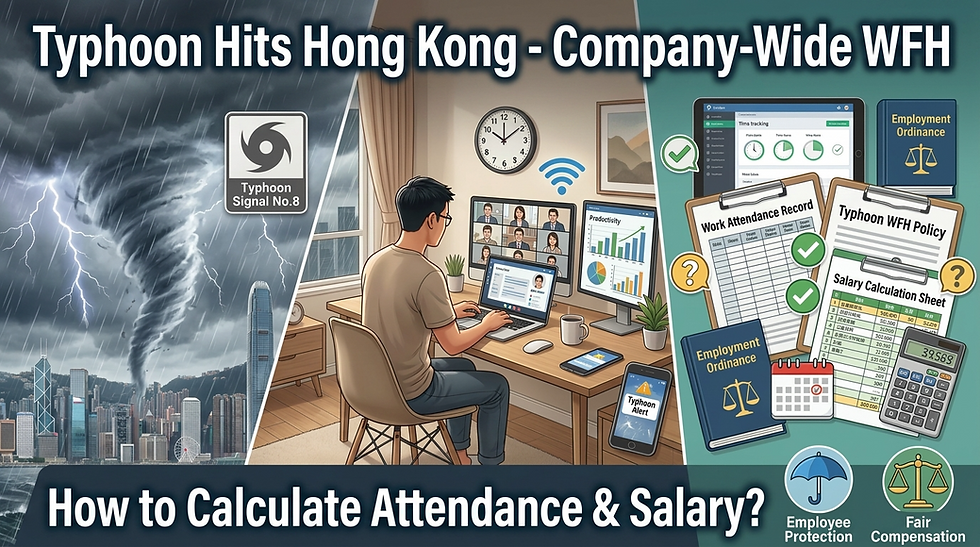
In Hong Kong, a Typhoon Signal No. 8 used to mean a city-wide shutdown and a welcome "typhoon holiday" for employees. However, with the rise of Work From Home (WFH), this traditional concept is being challenged. When a company is already equipped for WFH, can a Signal No. 8 still be a valid reason for "not working"? If an employee insists that "a typhoon signal means a holiday" and refuses to log in, can the employer deduct their salary?
This article delves into the Hong Kong Employment Ordinance and the latest Labour Department guidelines to explore attendance requirements, wage calculations, and legal risks under the WFH model during typhoons, helping employers and HR clarify rights and responsibilities to avoid labor disputes.
1. Is it Legal to Require WFH Under Typhoon Signal No. 8?
Under Hong Kong law, there is no statutory requirement for a "typhoon holiday." If the employment contract or company policy already includes WFH arrangements and there are no safety risks for the employee working from home, it is legal for an employer to require employees to continue remote work during a Signal No. 8.
Legal Background: No Statutory "Typhoon Holiday"
The Hong Kong Employment Ordinance does not mandate holidays during adverse weather. Traditionally, work suspension occurred because employers have a duty to ensure the safety of employees traveling to and from the workplace (under the Occupational Safety and Health Ordinance). However, under the WFH model, employees do not need to commute, significantly reducing safety risks, so the "safety reason" is no longer an automatic excuse for stopping work.
Contract Terms are Key
If an employee's contract explicitly states "required to work from home during adverse weather" or if the company has implemented regular WFH, the employee has a duty to perform their tasks. If the contract is silent, it depends on past practices or immediate negotiation between both parties.
2. Can Employers Deduct Salary if an Employee Refuses to WFH?
If an employee refuses to work despite having WFH capabilities and no reasonable obstacles (such as power outages or internet failure), the employer may treat it as "absence from work." According to Section 32 of the Employment Ordinance, employers can deduct wages for the actual time of absence, but cannot impose additional fines.
What are "Reasonable Obstacles"?
Employers must consider the following practical difficulties when requiring WFH:
•Internet or Power Outages: Typhoons may cause power cuts or broadband failures in certain areas.
•Family Care Pressure: During school closures, employees may need to care for children at home.
•Equipment Limitations: Whether the employee has the necessary equipment at home (e.g., computer, VPN).
Recommended Handling:
Situation | Recommended Action | Legal Risk |
Unjustified refusal to WFH | Deduct salary based on absence time. | Ensure WFH policy was communicated in advance. |
Unable to work due to power/internet failure | Be considerate; do not deduct salary. | Forced deduction may lead to "constructive dismissal" disputes. |
Lower efficiency due to childcare | Be flexible; allow asynchronous work. | Show corporate care to boost employee loyalty. |
3. Does an Injury During WFH Count as a Work Injury?
Yes. According to the Employees' Compensation Ordinance, as long as the injury occurs "out of and in the course of employment," even while working from home, the employer is liable for compensation.
Difficulty of Proof
Disputes over WFH work injuries usually center on whether the injury was work-related. For example, if an employee is injured due to a broken chair while working at a computer, it is usually a work injury; however, if they are scalded while cooking in the kitchen, it is harder to define as a work-related injury.
Employer Self-Protection Tips:
•Define Working Hours: Require employees to "clock in" or report on communication software during WFH.
•Safety Guidelines: Provide safety advice for the home office environment (e.g., posture, cable placement).
4. 2026 Advice for Harmonious Labor Relations: Pre-set WFH Typhoon Policies
To avoid disputes, employers should reach a written agreement with employees before the typhoon season, clarifying expected output, communication channels, and handling mechanisms for emergencies under WFH.
Policy Template Key Points:
1.Applicable Personnel: Which roles must WFH and which are exempt.
2.Wage Arrangements: Clarify that wages are paid during WFH, but outline handling for those who refuse to work.
3.Reporting Mechanism: How to immediately report if power or internet failures occur at home.
4.Resumption Arrangements: Whether employees need to return to the office if the signal is lowered during office hours.
Need Professional HR Advice? Let Get More Safeguard Your Interests
When facing complex employment contracts and payroll issues, having a professional HR consultant by your side is crucial. Get More Resources Limited, as a leading HR strategic partner in Hong Kong, has over 15 years of experience providing tailor-made HR solutions for over 5,000 companies.
Whether you need to understand your employment rights, negotiate contract terms, or require professional legal and HR guidance, Get More's expert team is ready to serve you. We provide not only HR outsourcing services but, more importantly, strategic human resources insights to help you protect your rights throughout your career.
Contact us now for a free initial consultation:
•📞 Phone: (852) 2333 1090
•📧 Email: HR@getmore.com.hk
Disclaimer:
The content of this article is for informational purposes only and is intended to provide general legal information and HR management advice. It does not constitute professional legal advice in any form. Hong Kong's laws and regulations may change at any time, and each case has its unique circumstances. Readers should consult a professional lawyer or the Labour Department before making any business or legal decisions. Get More Resources Limited is not responsible for any loss or impact arising from the use of the information in this article.


